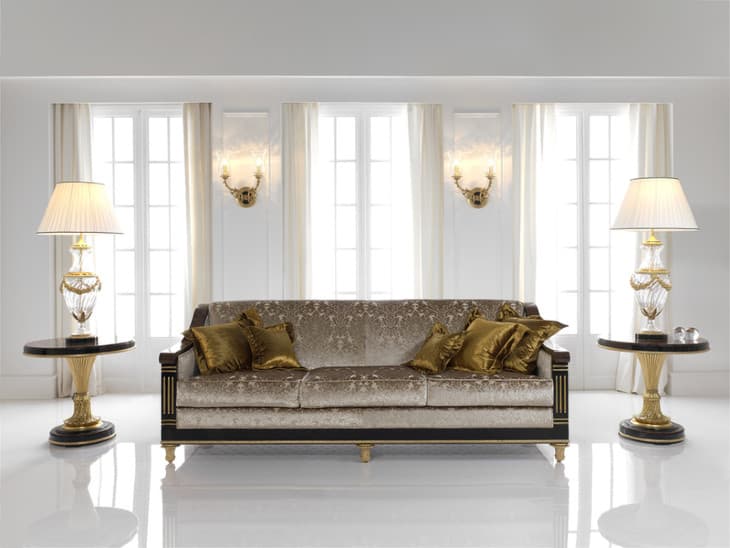
Selecting the right furniture and accessories for a living room isn't easy. That's why, at Mariner Luxury, as specialists in luxury decoration and design, we bring you this article explaining the key pieces for these spaces, the basic rules to keep in mind, and the lighting, textiles, and layout to follow to create the perfect classic and sophisticated living.
7 key pieces for a classic and sophisticated living room
Basic rules before choosing pieces
Proportions, symmetry, and visual axes
Balance is the foundation of any sophisticated classic living room. Therefore, before selecting furniture, it's essential to analyze the architecture of the space, identify a focal point, and work from there. Proportions also play a fundamental role: classic living rooms should be harmonious, meaning that no single piece should stand out excessively.
Symmetry is a very useful resource, as it helps to create visual order and provides an immediate sense of sophistication. Furthermore, identifying the visual axis of the space (a mirror, a work of art, a fireplace, a window) allows you to organize the other elements accordingly, creating fluidity and elegance.
Palette, materials and consistency of finishes
In classic style, neutral and warm tones—beige, cream, sand, taupe, and stone gray—are timelessly dominant. Occasionally, to add depth, accents in stronger or more intense tones such as burgundy, midnight blue, or English green are incorporated.
Regarding materials, classic decor typically favors nobility and permanence: dark woods, polished marbles, aged bronzes, deep lacquers, or luxurious upholstery. Maintaining consistency in the finishes is essential to convey continuity and enhance the feeling of luxury.
The 7 key pieces of the classic living room
Main sofa (shape, upholstery and dimensions)
The main sofa is the heart of a classic living room. It's best to choose a model with elegant lines, a high or tufted back, and curved arms that add presence. Upholstery should be in velvet, chenille, silk, or heavy linen, as these materials are ideal for adding a touch of distinction.
In terms of size, the sofa should be in proportion to the space: a large living room can accommodate a longer sofa or even a classic L-shaped one; whereas in smaller rooms, a two- or three-seater sofa is best. The key is to allow for comfortable movement around the sofa and prevent it from dominating the room.
Pair of armchairs (balance and conversation)
The seats provide balance, frame the central area, and transform the space into a social, welcoming, and functional area.
In classic living rooms, it's common to incorporate a pair of armchairs symmetrically placed opposite the sofa or slightly angled to facilitate conversation. These pieces should complement and share an aesthetic language with the sofa (coordinating tones and materials).
Coffee table (material, height and circulation)
Coffee tables are the pieces that visually organize conversation areas. In classic living rooms, the most suitable materials for these tables are fine woods with metallic details, marble, or beveled glass.
The ideal height for coffee tables is usually between 40 and 45 cm, to ensure comfortable use from sofas and armchairs. Regarding size, it's recommended that these pieces represent approximately 60% of the sofa's width.
To maintain adequate circulation in the rooms, there must be a free space of about 40-50 cm around the table.
Console or sideboard (storage and feature wall)
Console tables or sideboards add structure and functionality to living rooms. They are usually placed against a feature wall, under a mirror or a work of art, or, if the layout allows, behind the sofa.
These pieces of furniture, in addition to providing the necessary storage to keep the space tidy, also allow you to display lamps, sculptures, books or vases on them and help to reinforce the classic aesthetic of the rooms through details such as moldings, inlays or finishes in careful wood or lacquer.
Chandelier / central lighting (scale and drop)
A key and iconic element of any classic living room is the chandelier, as its presence adds character, illuminates the space evenly, and adds a touch of timeless luxury.
To make the right choice, it's essential to consider its scale: it should be proportional to the size of the room and neither too small nor too large. The ideal height is about 210–230 cm from the floor (depending on the ceiling height).
Anchor mat (dimensions and area framing)
Rugs serve as visual anchors. To achieve this, they need to be large enough to support the front legs of the sofa and armchairs, creating an "island effect" that brings the furniture together and unifies the living room.
Neutral tones, soft textures, and discreet patterns are ideal for rugs, as they do not compete with the prominence of the furniture.
Focal mirror/artwork (hierarchy and height)
Well-chosen focal points give living rooms personality and a sense of importance. For example, an ornate mirror or an elegantly framed classic or contemporary work of art can become the defining pieces of the room.
The ideal height for hanging these items is usually around 1.60–1.70 m from the ground, at the average natural eye level.
Layered lighting to enhance the overall effect
Environmental, task, accent and decorative
Classic and sophisticated living rooms require layered lighting:
- Ambient light: Provides a base.
- Task light: Illuminates specific areas, such as reading nooks.
- Accent light: Highlights decorative elements.
- Decorative lighting: Such as table lamps or wall lights, which add warmth.
Dimmer and basic scenes (reading, reception, relaxation)
Light dimmers allow you to adapt the atmosphere to suit the use of the space. Creating scenes for reading, entertaining, or relaxing helps create more comfortable and versatile living spaces.
Textiles and finishes that work
Fine upholstery and a mix of textures
Fine upholstery, cushions with different textures, generous curtains, and quality blankets add depth and sophistication, as these textiles make all the difference.
Metals, woods and lacquers: safe combinations
To avoid mixing too many materials and maintain balance, the most logical thing is to use safe combinations such as warm metals with fine woods and deep lacquers.
Distribution and circulation
Recommended distances between pieces
Ideally, or recommended, you should leave between 40 and 50 cm in front of the sofa and at least 90 cm in walkways. This ensures comfortable movement in living rooms.
Conversation and passage areas
The living room should be a space that encourages conversation and whose layout allows for unobstructed movement. Flowing living rooms are considered more elegant.
Details that make a difference
Cushions, books, flowers and trays
Accessories are truly important when it comes to adding personality to a living room, so they should be chosen carefully to avoid clutter or clashing. Art books, fresh flowers, elegant trays, and quality cushions are usually good choices.
Pairs and repetitions for visual order
Repeating elements (two lamps, two vases, two armchairs) helps to reinforce the balance inherent in the classic style and provides visual clarity.
If you'd like to learn more about how to properly decorate a classic and sophisticated living room, visit our website or contact us. We offer the best materials and have top specialists who will help you with everything you need.